First, you should be aware that todays 17 digit VIN or Vehicle Identification Number is a recent standard and Matra Automobiles only changed over to this during 1981 (for the 1982 model year). Like most car manufacturers, they had their own system previous to this. These could take almost any form!
If you have a Matra Djet / Jet, the chassis number should tell you which version it is. Please note: there should be NO apostrophe in Djet. If it starts MB8 10... it is a Djet 5. If it starts MB8 20... it is a Djet 5S. If it starts MB8 30... it is a Jet 6. If you have a René Bonnet Djet (models 1 to 4) it will start CRB ... and be extremely rare, one of only 198 made. The Djet 1 was a standard chassis with standard 1108cc engine. The Djet 2 (only 34 made) was a standard chassis with a modified engine. Many Djet 1 have since been uprated of course. Djets 3 and 4 were works prototypes and Aerojets with tubular space-frames and bonded on bodywork. If you speak French, the French Djet clubs may provide better help, alternatively, send me all the information you can (incl. photos) and I will try to find out what I can for you.
A 530A or 530LX has a split targa roof (two removable panels) and pop-up headlamps whilst the 530SX has a fixed roof and four large fixed lamps mounted on the front (rallye style). You may be interested in where this model name came from: Matra's main business at the time was military armament and they produced a very successful missile named the 'S530' (eventually replaced by the well known Exocet!). Whilst the Jet name of the first car model was chosen by René Bonnet before Matra took him over, it seems they decided to continue the theme. Maybe they hoped the missiles success would be transferred to the car!
If you have a Bagheera the chassis number will tell you it's age as well as the version. It was named after the Disney Jungle Book black panther character. (They couldn't use either Panther or Jaguar, suitable names that conjure up speed, grip, grace, etc. since there were other manufacturers with those names!) The chassis number takes the form of 'X3 550 7 X 40 7000'. The start 'X' denotes a transverse power unit so 'X3' or 'X6' means transverse 1294cc or 1442 cc engine respectively. The number '550' after this is the Bagheera factory model code. (Out of interest the '540' was a re-engined '530' prototype, and the '560' was the twin engined Bagheera U8 prototype). The number immediately preceding the middle X denotes the model year. So '4' means 1974 increasing to '9' for 1979. The letter 'A' is for 1980. The first two digits of the last six also relate to, and confirm the age since the first model year (74) they were '10' the second year they were '11' the third year they were '30'. In late '76 they brought out the Series 2 Bagheera for 1977 and the first two digits were '40', for '78 they were '45', for '79 they were '50' and for 1980 they were '55'. There were only just over 2000 made of the 1980 year model and these cars were slightly different in a number of ways and the format of the chassis number was slightly different too but the 'A' in the chassis number as well as other things will positively identify a 1980 car. Also by '79/80 Simca had dropped the 1300cc engine, so the low powered Bagheera was fitted with a 1442cc with only one twin-venturi carburettor, whilst the more powerful version had the normal two twin-venturi carbs.
The Murena continues this age designation with 'B' for 1981 to 'E' for 1984. However, the Murena chassis number can take two forms and the early models were similar to the Bagheera but after the PSA takeover of Simca it changed to the 17 digit international standard format (VIN). So 1981 models take the 'X5 551 BX 60 0000' form, whilst from 1982 onwards they are like this: 'VF8 53C 392 CX 65 0000'. The designation '551' (old style chassis number) or '392' in the new VIN form, denotes a 1.6 engine model and either '552' or '432' means a 2.2 engine model. Again the first two digits of the last six confirm the series and age - '60' is a 1981, '65' is a 1982 and '70' is a 1983'. Note: only 2.2S models had the 1984 'E' designation and their chassis numbers were all 75 0000 upwards. There were only 480 'S' models and the 'EX 75....' part of the VIN will positively identify one. The word 'Murena' is French for a Moray eel! Like the Bagheera the initial 'X' denotes a transverse power unit. So an X5N2 engine code is a transverse 2.2-litre whilst a '9N2' is the longitudinal version of that engine as fitted in the Tagora 2.2 model. I point this out since there are a number of Murena running around with modified Tagora engines in them. If your Murena engine block has '7T2' cast in it, it is only a 2.0-litre unit from a Chrysler 2.0-litre! (unless you can find the 'X5N2' stamped next to the '7T2' casting or engine number)
The Rancho chassis number also takes two formats as it was produced under both Simca and PSA (Talbot). Early cars used the 'X3 012 9 X 50 0000' format. (This would be a 1979 model) and from '82 onwards they used the new international standard 17-digit number, such as 'VF8 31D 331 CX 65 0000' etc. All Rancho have 1442cc engines. The 'VF8' start of the VIN in Murena, Rancho, Espace and Avantime models denotes that these vehicles are made by Matra Automobiles in France. VF=Vehicle France and the number 8 is Matra (remember the '8' in MB8=Matra-Bonnet) VF1=Renault, VF2=Simca, VF3=Peugeot, VF4=Talbot, VF7=Citroen etc.
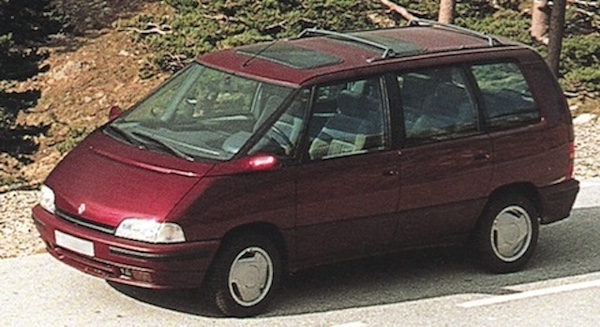
Matra produced the Espace from its inception in 1984 to 2002 when Renault designed the fourth version based on the Laguna II floorpan, and moved production in-house. So when talking about Matra Espace there are three versions or Series. The first version however, came in two phases, mainly because the original, which had been designed for Talbot, did not have the corporate look and in fact used Talbot head lamps, and once it was decided the new concept was successful enough to continue, they produced a facelift model with the familiar Renault style front. Unfortunately there are many incorrect references around and even the Haynes manual has the nomenclature wrong, so remember, the following are the correct names:
Espace 1 Phase 1 1984 - 1988 (both external mirrors on doors, forward slant to Talbot rectangular head lamps) Phase 1 image
Espace 1 Phase 2 1988 - 1991 (virtually the same bodywork as Phase 1, but rearward slant to Renault style head lamps and front grille) Series 1 Phase 2 NOT a Series 2.
Espace 2 1991 - 1996 (all new bodywork, totally new interior, and ext. mirrors forward of the doors blending with curved front bodywork) Espace Series 2
Espace 3 1996 - 2002 (major change to transverse power-trains, different chassis, body and interior, ext. mirrors have intake vents for heating) Series 3 image
Model years are not the same as calendar years! They start in advance of the new year. How much in advance is a little 'flexible'. For instance all the first Bagheera were plated 1974 yet the production started around the middle of 1973. The Murena 1.6 started production in September 1980 and did not go on sale until December 1980, but all were plated 1981. Murena 2.2 Production started in February 1981 and went on sale from May 1981. All 2.2S were plated as 1984 models, but were built towards the end of 1983. This is why you may have a car first registered say 1980 but it's plated 1981. Note, all manufacturers tend to do this - it is not unusual to Matra.
If you are interested to know why this is common practice, it was started in America many years ago when they had a new model (or version of any model) every year, and new buyers at the beginning of January wanted their new cars to be the new year models! Now it is impossible to manufacture thousands or millions of new cars for availability at the start of the new year unless they were actually made during the end of the previous year. So they started the next years models during the latter stages of the year but plated them for the following year, just so buyers could go in and buy 'this years model' at the beginning of January! Therefore it was actually a system created to satisfy the wishes of new U.S. buyers.
The Djet / Jet models used Renault 4 cylinder in-line engines:
An 1108cc for the 5 & 5S and a Gordini modified 1255cc for the Jet 6.
The 530 models used Ford (of Germany) engines:
They were the 1.7 litre V4 used in the Taunus (and some Saab's).
The Bagheera used French Simca 4 cylinder in-line engines:
They were either the 1294 cc or 1442 cc transverse units taken from the Simca 1100 / Horizon / 1307 (or Alpine) / 1308 (or Solara) range.
The Rancho used the same 1442 cc as the Bagheera but in a lower state of tuning.
It has one carburettor rather than two, and a lower compression.
The Murena used French Simca / Talbot 4-cylinder in-line engines:
The 1.6 from the Alpine / Solara and the 2.2 OHC from the Tagora 2.2
Please note: this 2156 cc engine was a development of the Chrysler Type 180 unit NOT the 2165 cc Peugeot 505 Douvrin engine with which it sometimes mistakenly credited.
Also note that in Germany the 2.2 was classified as 2128cc. This is only a fiscal rating and the true capacity is still 2156cc like all the other 2.2 models sold.
Back to top
The Djet / Jet used the commercial Renault Estafette 4-speed transaxle.
The 530 models used the Ford Taunus 4-speed transaxle.
The Bagheera and Rancho used the Simca 1100 / 1307 / 1308 4-speed transaxle.
The Murena uses a slightly modified Citroën CX 5-speed transaxle.
All these were modified from the originals where necessary.
Figures for the earliest cars are difficult to be accurate about, but the general consensus is as follows: There were 198 Bonnet Djet cars built (versions 1 to 4) before the Matra takeover when they became first Matra-Bonnet and then Matra-Sport. There were then a total of 1493 Matra-Bonnet or Matra-sport Djet / Jet models; 916 were model 5, 355 model 5S and 222 model 6, production ending in 1967. There were 9609 530 models; 3731 model 530A, 4732 model 530LX and 1146 model 530SX. The Bagheera was the most prolific of the sports cars having a total of 47,796 cars made. The series 1 was made up until 1976 with the series 2 running until 1980. Although the change took place late in 1976, all series 2 were plated 1977. There were 25,477 series 1 and 22,319 series 2 Bagheera. The Rancho came in a variety of specifications and was available from 1977 to 1984 and was the only one of these cars to be available from the factory in RHD. A total of 57,792 were produced. There were 10,680 Murena produced: 5640 1.6 models, 4560 2.2 models of which it is believed 112 were dealer converted to Prep 142 specification, and finally the 480 'S' based on the Prep 142 specification. The Matra produced Espace, production of which ended near the end of 2002, totalled 874,242. The Avantime production totalled 8,450 from 2001 to 2003 with I believe just 1000 RHD cars, of which 452 were sold in the U.K.
The Djet / Jet has a tubular steel chassis with glass fibre (GRP) bodywork. It has a large round longitudinal backbone tube with square tube outer framework. The 530 and Bagheera have flat steel platform chassis with glass reinforced polyester bodywork. The Rancho is based on the Simca 1100 pick-up so the chassis and front bodywork are steel and only the rear upper section of bodywork is glass reinforced polyester. The Murena and Espace use a totally immersed hot-dip galvanised platform steel chassis with polyester and glass fibre bodywork. The Avantime is similar to the Espace but some of the upper chassis is aluminium.
Back to top